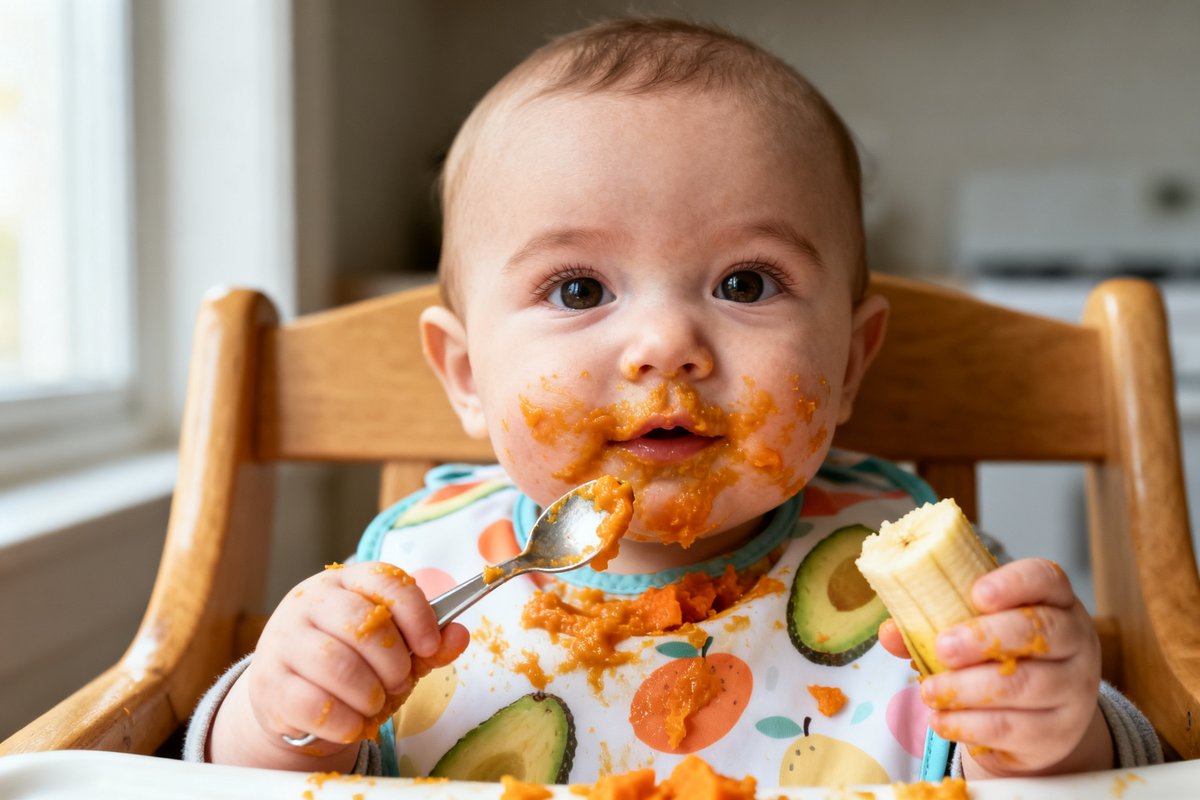
Most babies are ready for solids around 6 months, indicated by good head control, sitting with support, and loss of tongue-thrust reflex.
Start with single-ingredient foods and introduce new foods one at a time to watch for allergic reactions.
Baby-led weaning lets babies feed themselves soft, gummable pieces of food from the start, skipping purees entirely.
Iron-rich foods like pureed meat, fortified cereal, and well-cooked eggs should be among the first foods offered.
Choking and gagging are different — gagging is normal and protective; choking requires immediate intervention.
Is Your Baby Ready for Solids? Key Developmental Signs
Introducing solids is an exciting milestone, but timing matters. Starting too early can pose choking risks and may not provide nutritional benefit since breast milk or formula remains the primary nutrition source for the first year. Starting too late may delay oral motor skill development and make acceptance of new textures more difficult.
The American Academy of Pediatrics recommends exclusive breastfeeding or formula feeding for about six months, with solids introduced around six months. However, readiness is determined by developmental signs, not just age. Your baby is likely ready when they can sit with minimal support, hold their head steady, and have lost the tongue-thrust reflex that automatically pushes food out of the mouth.
Other readiness signs include showing interest in food — watching you eat, reaching for your food, opening their mouth when food approaches — and being able to pick up food and bring it to their mouth. Some babies show these signs as early as five months; others may not be ready until seven months. There is no prize for starting early.
Starting solids is messy and that is part of the learning process. Your baby is learning to manipulate food in their mouth, coordinate swallowing, and explore tastes and textures. Expect more food on the floor, in their hair, and on their clothes than in their mouth, especially in the early weeks.
Every child develops differently, and these general parenting guidelines should be discussed with your healthcare provider for personalized advice.
First Foods: What to Offer and How to Prepare Them
The best first foods are soft, easy to swallow, and nutrient-dense. There is no medical reason to introduce foods in a specific order. Traditional advice to start with rice cereal is outdated — you can start with any healthy, age-appropriate food. Iron-rich foods are particularly important because your baby's iron stores begin depleting around six months.
Excellent first foods include well-mashed avocado, steamed sweet potato sticks, pureed or mashed banana, well-cooked and finely chopped broccoli florets, plain full-fat yogurt, pureed meat or poultry, iron-fortified infant cereal mixed with breast milk or formula, and soft, ripe pear slices. Each food should be soft enough to mash between your thumb and forefinger.
Introduce new foods one at a time with a few days between each to watch for allergic reactions. Signs of an allergic reaction include hives, facial swelling, vomiting, diarrhea, or difficulty breathing. If you notice any of these symptoms, stop offering that food and contact your pediatrician. Common allergens include peanuts, tree nuts, eggs, dairy, soy, wheat, fish, and shellfish.
The LEAP study and subsequent research have changed peanut introduction guidelines significantly. Current recommendations suggest introducing peanut-containing foods early, around 4-6 months, especially for high-risk babies with severe eczema or egg allergy. Talk to your pediatrician about the best approach for introducing allergens to your baby.
Texture progression is important. Start with soft, mashed or pureed foods around 6 months. Progress to soft, gummable chunks around 7-8 months. Offer soft finger foods around 8-10 months. Introduce finely chopped table foods around 10-12 months. Your baby will signal when they are ready for more texture by reaching for your food and managing current textures well.
Baby-Led Weaning vs Traditional Purees
Baby-led weaning (BLW) is an approach where babies feed themselves soft, age-appropriate finger foods from the start, skipping the puree stage entirely. Babies eat what the family eats (with modifications for safety) and control how much and how fast they eat. Proponents believe BLW promotes healthier eating habits, better oral motor development, and greater independence.
The traditional approach involves feeding your baby purees with a spoon, gradually increasing texture from thin purees to thick mashes to soft chunks to finger foods. This approach allows parents to control portion sizes and ensure specific nutrients are consumed. It can be less messy and may be easier for parents who worry about choking.
Both approaches are valid, and many families use a combination. You might offer purees for iron-rich foods like meat while letting your baby self-feed soft vegetables and fruits. Or you might start with purees and transition to finger foods as your baby's pincer grasp develops around 8-9 months. What matters most is that your baby gets adequate nutrition and develops positive associations with mealtime.
If you choose baby-led weaning, follow these safety guidelines: always supervise your baby during eating, offer foods cut into safe shapes (spear-shaped pieces about the size of your finger), avoid round or coin-shaped foods like whole grapes and cherry tomatoes (cut them lengthwise), and ensure all foods are soft enough to mash between your fingers.
Regardless of your approach, responsive feeding is key. Offer food, but let your baby decide whether and how much to eat. Do not pressure, coax, or distract your baby into eating. Trust their innate ability to self-regulate intake. Mealtime should be positive and stress-free. Your job is to provide healthy options; your baby's job is to decide what and how much to eat from those options.
Trust your instincts as a parent. You know your child better than anyone else. When something does not feel right, speak up and ask questions.
Frequently Asked Questions
What is the difference between gagging and choking?
Gagging is a normal protective reflex that helps prevent choking. A gagging baby may make retching sounds, stick out their tongue, and have watery eyes, but they are breathing and making noise. Choking is silent — a choking baby cannot cough, cry, or make any sound, and may turn blue. Learn infant CPR and choking rescue before starting solids. Never put your fingers in a gagging baby's mouth, as this can push food further back.
How much solid food should my baby eat at each meal?
In the beginning, solids are more about exploration than nutrition. One to two tablespoons of food once daily is plenty. By 7-8 months, gradually increase to 2-3 tablespoons per meal, 2-3 times per day. By 9-12 months, aim for 3-4 tablespoons per meal, 3-4 times per day. Breast milk or formula remains the primary nutrition source until about 12 months.
Can I mix breast milk or formula into solid foods?
Yes, mixing breast milk or formula into purees or mashed foods creates a familiar taste and thinner consistency that many babies prefer. However, do not add cereal or purees to a bottle unless specifically instructed by your pediatrician. This is a choking hazard and can interfere with your baby's ability to self-regulate intake.
When can I give my baby water?
You can offer small amounts of water (2-4 ounces per day) in an open cup or straw cup once solids are introduced around 6 months. Water helps prevent constipation as your baby begins eating more solid foods. Do not give juice to infants under 12 months. Whole cow's milk should wait until 12 months.
Conclusion
Introducing solids marks the beginning of your baby's lifelong relationship with food. Whether you choose baby-led weaning, traditional purees, or a combination approach, the most important factors are safety, responsiveness to your baby's cues, and maintaining a positive, low-pressure mealtime environment. Trust your baby's ability to learn this new skill at their own pace.
This information is provided for general parenting guidance and educational purposes. Always consult with your healthcare provider for medical advice specific to your situation.
Navigating Picky Eating in Babies and Toddlers
Picky eating is a normal developmental phase that most children go through, typically peaking around age two. Understanding this helps parents respond with patience rather than frustration. Children taste buds are more sensitive than adults, and many foods that seem mild to adults can be overwhelming to young children. Repeated exposure is the key to acceptance. It can take ten to fifteen exposures to a new food before a child accepts it. Do not pressure, bribe, or force. Simply offer the food alongside familiar favorites and let the child decide whether to try it.
Creating a positive mealtime environment supports healthy eating habits. Eat together as a family whenever possible, with everyone eating the same meal. Avoid making separate meals for picky eaters. Offer at least one food at each meal that you know your child will eat, alongside new or less preferred foods. Keep the atmosphere relaxed and pleasant. Children who feel pressured at meals often develop stronger food aversions. Trust your child ability to eat the amount they need. When parents control what food is offered and children control what and how much they eat from what is offered, mealtime power struggles decrease significantly.