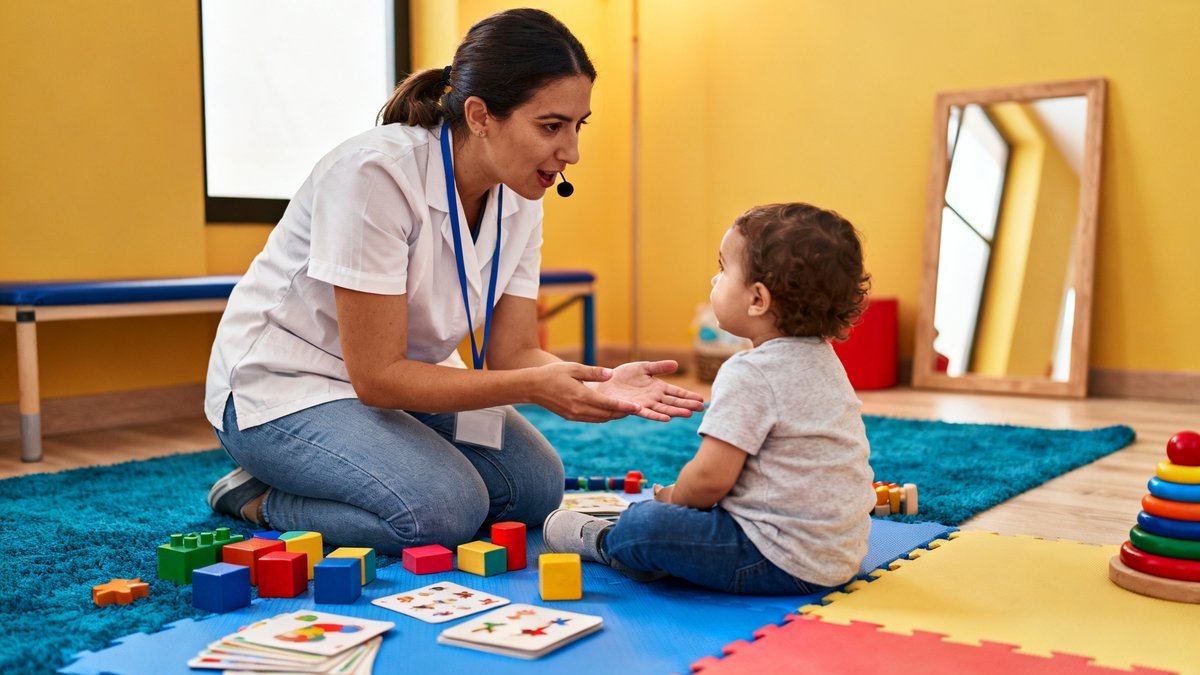
Speech refers to the physical production of sounds; language refers to the understanding and use of words to communicate meaning.
By 12 months, most babies say 1-3 words; by 24 months, most have at least 50 words and combine two words into simple phrases.
Red flags include no babbling by 9 months, no first words by 15 months, no two-word phrases by 24 months, and loss of language skills at any age.
Early intervention for speech and language delays is most effective when started before age 3.
Hearing problems are a common cause of speech delay and should always be ruled out first.
Understanding Speech vs Language and Typical Milestones
Speech and language are related but distinct skills. Speech is the physical ability to produce sounds and words using the lips, tongue, and vocal cords. Language is the broader system of using words and gestures to convey meaning, including understanding what others say (receptive language) and expressing thoughts (expressive language). A child may have good speech but delayed language, or vice versa.
From birth to 3 months, babies communicate through crying, cooing, and making pleasure sounds. They turn toward voices and recognize their parents' voices. From 4-6 months, babbling begins with consonant-vowel combinations like ba-ba and ma-ma. Babies experiment with sounds, squeal, and blow raspberries. They respond to their name and begin to recognize familiar words like bye-bye.
From 7-12 months, babbling becomes more sophisticated with varied sounds and intonation patterns that mimic the cadence of adult speech. First words typically emerge around 12 months. Babies understand far more than they can say at this stage — they follow simple directions like come here when accompanied by gestures and recognize names of familiar objects and family members.
From 12-24 months, vocabulary expands from about 1-3 words at 12 months to 50-100 words or more by 18 months, and 200-300 words by 24 months. Two-word combinations emerge around 18-24 months. Toddlers begin to understand basic concepts like in, on, and under. They can follow two-step directions like pick up the ball and give it to Daddy.
From 2-3 years, vocabulary expands to 500-1000 words. Children use three-to-four-word sentences, ask questions, and carry on simple conversations. Their speech should be understandable to familiar listeners about 75 percent of the time by age 3. From 3-5 years, language becomes increasingly complex. By age 5, children use adult-like sentence structures and can tell detailed stories.
Every child develops differently, and these general parenting guidelines should be discussed with your healthcare provider for personalized advice.
Red Flags: When to Be Concerned
Knowing the red flags for speech and language delays helps you seek timely support. Remember that these are guidelines, not absolute rules. A single missed milestone does not necessarily indicate a problem, but persistent delays across multiple milestones warrant discussion with your pediatrician.
Red flags in the first year include: not responding to sounds (0-3 months), no cooing or social smiling by 3 months, no babbling by 9 months, no gesturing (waving, pointing) by 12 months, and no first words by 15 months. Loss of babbling or vocalizations at any point in the first year is also a significant concern.
Red flags in the second year include: no single words by 15 months, fewer than 20 words by 18 months, no two-word combinations by 24 months, not following simple directions by 18 months, and regression — losing words or skills they previously had. Regression at any age is always a red flag that warrants immediate evaluation.
Red flags for preschoolers (3-5 years) include: speech that is mostly unintelligible to unfamiliar listeners by age 3, difficulty understanding simple questions by age 3, limited sentence length compared to peers by age 4, difficulty following multi-step directions by age 4, and stuttering that persists beyond 6 months or is accompanied by facial tension or avoidance of speaking.
If your child was developing speech and language typically and then loses skills, this is always concerning. Regression can be associated with various conditions including autism spectrum disorder, seizure disorders, or hearing loss. Report any loss of language skills to your pediatrician immediately.
When and How to Seek Professional Help
If you are concerned about your child's speech or language development, start with your pediatrician. They can perform a developmental screening, check your child's hearing, and make referrals to appropriate specialists. Trust your instincts — you know your child better than anyone, and parental concern is a valid reason to seek evaluation even if screening tools do not flag a problem.
Hearing evaluation should always be the first step when speech delay is suspected. Even mild or intermittent hearing loss from chronic ear infections can significantly impact speech development. An audiologist can perform age-appropriate hearing tests that do not require your child to respond verbally. Identifying and treating hearing problems often resolves the speech delay without additional intervention.
Speech-language pathologists (SLPs) are the professionals who evaluate and treat speech and language disorders. They assess your child's communication skills, identify specific areas of delay, and provide targeted therapy. Therapy may be covered by insurance, through early intervention programs (Part C of IDEA, for children under 3), or through the public school system (for children 3 and older).
Early intervention services are available in every state for children from birth to age 3 who have developmental delays or disabilities. These services are typically free or offered on a sliding scale and are often provided in your home or at your child's daycare. The earlier intervention begins, the better the outcomes. You do not need a doctor's referral to request an evaluation.
If your child is diagnosed with a speech or language disorder, you are your child's most important communication partner. Learn the strategies your speech therapist recommends and practice them throughout the day. Simple techniques like narrating your activities, expanding your child's utterances by adding one word, and reading books with lots of repetition support language development in natural, enjoyable ways.
Trust your instincts as a parent. You know your child better than anyone else. When something does not feel right, speak up and ask questions.
Frequently Asked Questions
My 18-month-old has no words yet. Should I be worried?
An 18-month-old with no words is considered delayed in expressive language and should be evaluated. Schedule a hearing test and request a speech-language evaluation. Early intervention can start before a formal diagnosis is made. Many children who receive early services catch up fully to their peers by kindergarten age.
Is screen time causing my child's speech delay?
Excessive passive screen time can displace the interactive back-and-forth communication that babies and toddlers need for language development. However, screen time is rarely the sole cause of speech delay. If your child has significant screen time, consider reducing it and increasing face-to-face interaction, reading, and conversational play.
What is the difference between a speech delay and autism?
Speech delay and autism are different conditions that can both affect communication. Children with speech delay typically have strong social engagement, eye contact, and desire to communicate, but struggle with the mechanics of speech or language. Children with autism spectrum disorder often have broader social communication challenges, including difficulty with eye contact, joint attention, and reciprocal conversation.
Should I be worried about stuttering in my 2-year-old?
Mild stuttering, or dysfluency, is common in toddlers and preschoolers as their language skills develop faster than their oral motor coordination. This developmental stuttering typically resolves on its own within 3-6 months. Seek an evaluation if the stuttering lasts more than 6 months, is accompanied by facial tension or physical struggle, or if your child seems to be avoiding speaking because of it.
Conclusion
Speech and language development unfolds at different rates for different children, but understanding typical milestones helps you recognize when your child might benefit from extra support. If you have concerns, act early rather than waiting to see if your child will outgrow the delay. Early intervention is effective, and your attentive involvement is the most powerful factor in your child's communication development.
This information is provided for general parenting guidance and educational purposes. Always consult with your healthcare provider for medical advice specific to your situation.
Creating a Language-Rich Home Environment
Language development flourishes in environments where children are exposed to rich, varied language throughout the day. Narrate your daily activities as you perform them, describing what you are doing, seeing, and thinking. This running commentary exposes children to sentence structure, vocabulary, and the connection between words and actions. Ask open-ended questions that require more than yes-or-no answers. Instead of "Did you have fun at the park?" try "What was the best part of the park today?" These conversations expand language skills while also deepening your connection with your child.
Reading aloud remains one of the most powerful language-development activities. The benefits of reading together extend well beyond early childhood. Even after children can read independently, reading more complex books aloud exposes them to vocabulary, sentence structures, and narrative forms beyond their current reading level. Discuss stories as you read, asking predictive questions, connecting events to your child experiences, and explaining unfamiliar words. A child who is read to regularly enters school with a significantly larger vocabulary and stronger pre-reading skills than a child who is not read to.