Table of Contents
Practical ADHD parenting strategies including effective routines, reward systems that work, and school advocacy tips to help your child succeed at home and in the classroom.
Jordan Myers
Practical ADHD parenting strategies including effective routines, reward systems that work, and school advocacy tips to help your child succeed at home and in the classroom.
Parenting a child with ADHD brings daily challenges that standard parenting advice often fails to address. Traditional discipline methods assume neurotypical brain wiring and frequently backfire with ADHD children. Effective ADHD parenting requires understanding how the ADHD brain works and adapting your approach accordingly. This guide offers practical strategies for routines, motivation, and school advocacy that actually work.
The ADHD brain struggles with time blindness, task initiation, and working memory. A routine that relies on self-motivation and remembering what to do will fail consistently. Externalize the structure: use visual schedules, alarms, timers, and checklists. The goal is to make the routine happen automatically without requiring your child to remember what comes next.
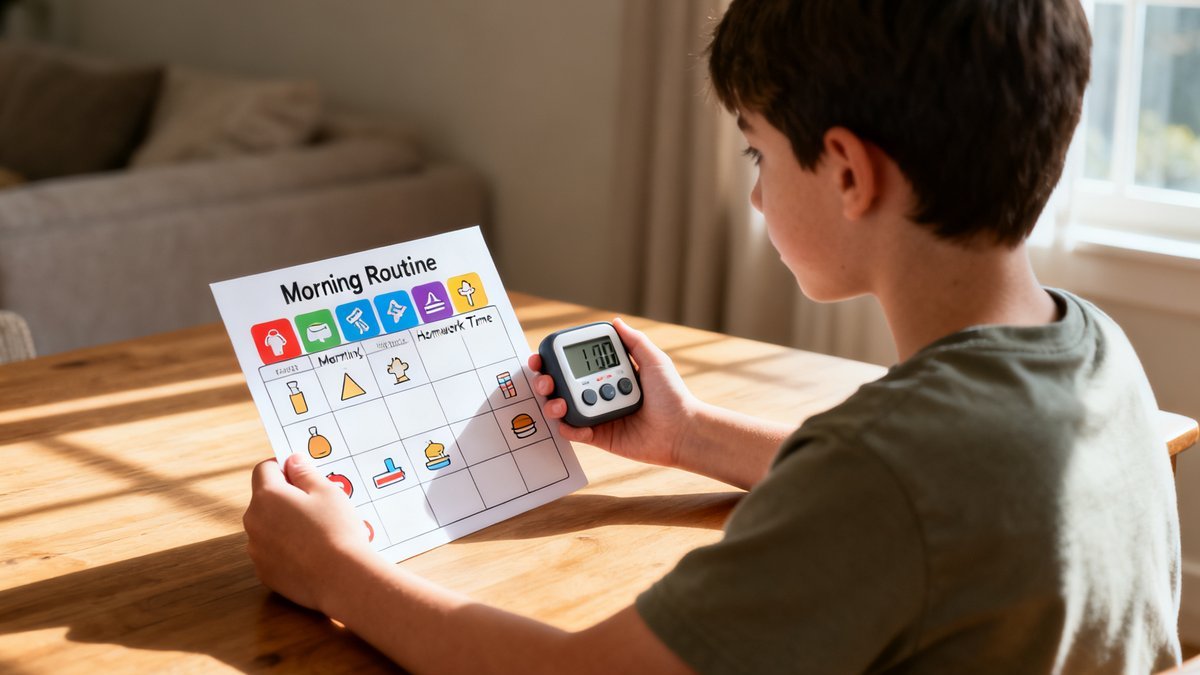
Morning and bedtime routines benefit most from structure because these transitions happen under time pressure. Create a step-by-step visual checklist for each routine. Use pictures for younger children, written lists for older ones. Set alarms for each transition point. Build in buffer time. An ADHD child who needs to leave for school at 8:00 should start their morning routine at 7:00, not 7:30.
Habituate routines by pairing new habits with existing ones. After you brush your teeth, you take your medication. After you put on your pajamas, you read for ten minutes. This technique, called habit stacking, leverages established neural pathways to build new routines without relying on willpower or memory.
The ADHD brain responds differently to rewards than the neurotypical brain. Delayed rewards like if you behave all week, you get a prize on Saturday have little motivational power for ADHD children. Immediate, frequent rewards work better. A token system where your child earns small rewards throughout the day capitalizes on the ADHD brain's need for instant feedback.
Focus on rewarding effort and process, not just outcomes. Did your child start homework without being reminded? That deserves recognition even if they only worked for five minutes. Did they remember to brush their teeth without prompting? Celebrate it. This approach builds momentum and reinforces the behaviors that lead to good outcomes.
Natural consequences are more effective than imposed punishments. If your child forgets their jacket, they will be cold on the way to the car. If they do not complete homework, they will need to talk to their teacher. Natural consequences teach real-world cause and effect without damaging your relationship. Reserve imposed consequences for safety issues and repeated patterns.
ADHD qualifies as a disability under the Individuals with Disabilities Education Act (IDEA) and Section 504 of the Rehabilitation Act. This means your child is entitled to accommodations and supports at school. The most common path is a 504 Plan, which provides accommodations like preferential seating, extended time on tests, and movement breaks.
Request specific accommodations based on your child's executive function challenges. If your child struggles with note-taking, request a copy of teacher notes or a note-taking buddy. If they have trouble with organization, request weekly check-ins with a teacher to organize their binder and agenda. If they struggle with test performance despite knowing the material, request extended time and a quiet testing environment.
Build a collaborative relationship with your child's teacher. Share what works at home. Ask what they observe in the classroom. Teachers who understand ADHD are valuable partners. Provide them with resources if they seem unfamiliar with ADHD accommodations. Regular communication, even a weekly five-minute email, keeps everyone aligned.
I spent years trying to discipline my ADHD child like I disciplined my neurotypical one. Nothing worked until I understood that his brain is wired differently. He is not choosing to be difficult. His brain literally cannot do what I am asking without the right supports in place.
The single most effective thing we did was externalize everything. Whiteboards, visual schedules, phone alarms, checklists. Stop trying to make his ADHD brain remember things. Write it down instead.
Rewarding effort changed our whole dynamic. Instead of only noticing when things went wrong, I started catching him doing things right. The behavior I focused on grew. It sounds simple but it transformed our home.
ADHD is a neurological condition with strong evidence supporting both medication and behavioral interventions. The most effective treatment is often a combination of both. Behavioral strategies build skills and routines. Medication addresses the underlying neurochemistry. Discuss options with a developmental pediatrician or child psychiatrist who specializes in ADHD.
Create a predictable homework routine with built-in movement breaks. Many ADHD children focus better after physical activity. Use a timer. Work for twenty minutes, break for five. Break assignments into small chunks. Let your child choose the order of tasks. If homework consistently takes more than an hour, talk to the teacher about reducing the workload.
This pattern is called masking or holding it together. Your child works hard all day to meet school expectations. When they come home to a safe environment, all that accumulated stress releases. This is a sign that you have created a safe home where your child can decompress. Provide a low-demand wind-down period after school before expecting homework or chores.
Frame ADHD as a brain difference, not a deficit. Your brain works differently, and different is not bad. Some things are harder for you, and some things are easier. Here are the tools and strategies that help your amazing brain do what it wants to do. Reading books about ADHD characters together can help normalize the experience.
Parenting a child with ADHD requires adapting your approach to match how their brain works. Build external structures that compensate for executive function challenges, use immediate rewards that motivate the ADHD brain, and advocate for school accommodations that level the playing field. Your child is not broken. They need different tools. You can help them find and use those tools effectively.
School can be particularly challenging for children with ADHD, who are expected to sit still, follow multi-step instructions, and sustain attention for extended periods. Advocating for classroom accommodations is essential. Common accommodations include preferential seating near the front of the room, extended time on tests, written instructions in addition to verbal ones, movement breaks during long work periods, and a quiet space for test-taking. These accommodations level the playing field without giving any unfair advantage.
A 504 Plan provides formal accommodations for students with ADHD who do not qualify for special education services under IDEA. Unlike an IEP, a 504 Plan does not provide specialized instruction but does ensure equal access to education through accommodations. Requesting a 504 evaluation is straightforward. Submit a written request to the school principal or special education coordinator. The school must evaluate your child within a reasonable timeframe and implement accommodations if the evaluation confirms that ADHD substantially limits a major life activity like learning or concentration.
Medication is a personal decision that should be made in consultation with your child doctor, but it is worth understanding the facts. Stimulant medications are the most studied and effective treatment for ADHD, with decades of research supporting their safety and efficacy when used as prescribed. Non-stimulant options are also available for children who do not respond well to stimulants. Medication does not cure ADHD but it reduces symptoms enough that behavioral strategies and classroom accommodations can work effectively. Many parents find that the combination of medication, behavioral therapy, and school accommodations provides the best outcomes for their child.
Executive function skills, the cognitive processes that enable planning, organization, impulse control, and flexible thinking, are often delayed in children with ADHD. These skills can be explicitly taught and strengthened through practice. Start with simple routines and gradually increase complexity. A morning routine checklist with pictures helps a young child move through tasks independently. A homework checklist for older children breaks assignments into manageable steps. Visual schedules, timers, and organizational systems compensate for underdeveloped executive function while building these skills over time.
Natural consequences are a powerful teacher for children with ADHD. If your child forgets their homework repeatedly, having them experience the natural consequence at school is more motivating than any consequence you enforce at home. However, balance natural consequences with support. The goal is to help children develop their own internal systems for staying organized, not to punish them for deficits they cannot fully control. Work with your child to identify which organizational strategies work for their unique brain rather than imposing adult systems that may not fit how they process information.