Table of Contents
Flying with a baby does not have to be stressful. Twenty-five practical tips covering pre-flight preparation, airport navigation, in-flight strategies, and landing recovery.
Jordan Myers
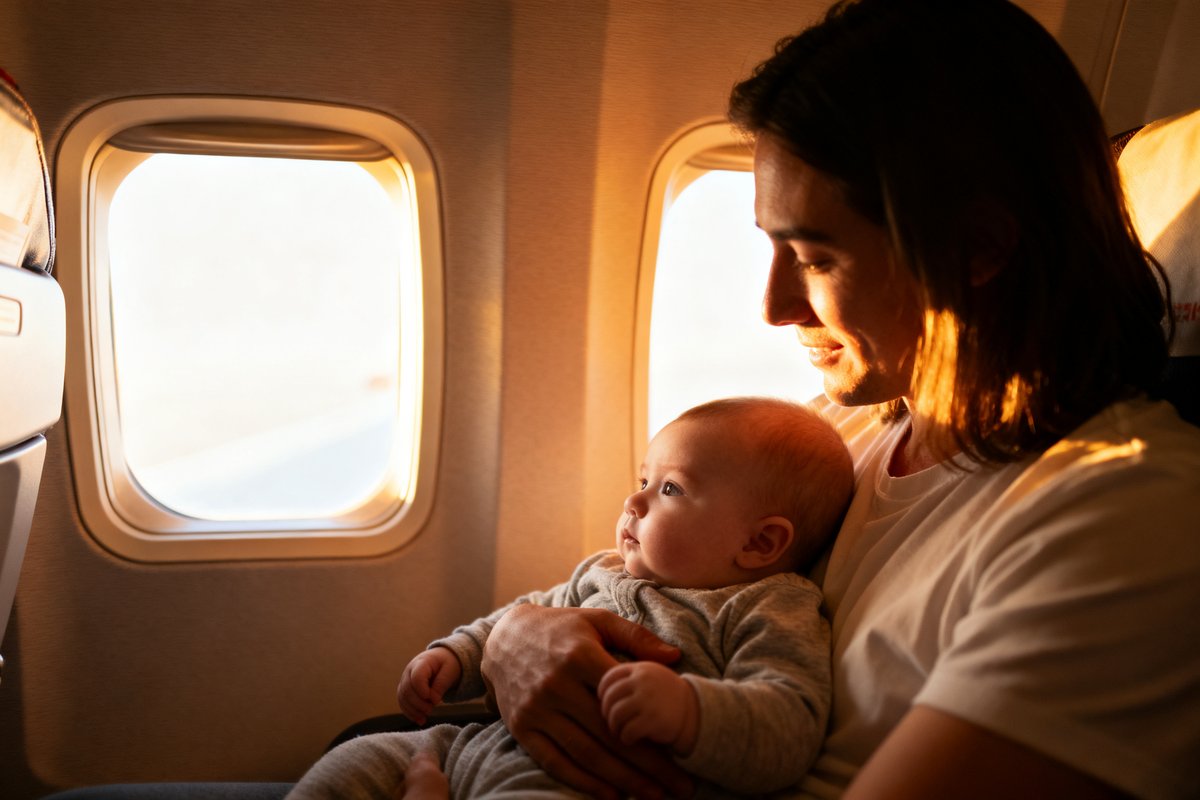
Flying with a baby does not have to be stressful. Twenty-five practical tips covering pre-flight preparation, airport navigation, in-flight strategies, and landing recovery.
Flying with a baby is one of those parenting experiences that people either romanticize or warn you about. The truth is somewhere in between. Preparation determines outcome. With the right strategies, you can manage flights with your baby smoothly and maybe even enjoy parts of the experience. These twenty-five tips cover every phase of air travel with a baby.
Book direct flights whenever possible. Each takeoff and landing is the hardest part for babies. Fewer flights means fewer pressure cycles. If direct flights are not available, choose layovers of at least two hours to give you time to change and feed between flights without rushing.
Choose flight times that align with your baby's sleep schedule. Red-eye flights work well for babies who sleep through the night. Early morning flights catch babies at their best. Avoid flights during your baby's fussy evening hours if possible. Most babies under six months travel more easily than older babies who have more awareness but less patience.
Reserve seats strategically. The bulkhead row offers more legroom and space for a bassinet on many international flights. A window seat gives your baby something to look at and a surface to lean against for sleeping. If traveling with another adult, book aisle and window so the middle seat often stays empty.
Pack a separate diaper bag that goes under the seat in front of you, not in the overhead bin. Contents: six to eight diapers for a long flight, a full change of clothes for baby and one for you, a large blanket that doubles as a nursing cover and changing pad, wipes, diaper cream, hand sanitizer, and plenty of plastic bags for soiled diapers and clothes.
Feeding supplies: for breastfed babies, bring a nursing cover if you use one. For formula-fed babies, bring pre-measured formula in a portion container and empty bottles. Buy water after security. Bring more formula than you expect to need. Flight delays happen. For older babies, bring pouches of pureed food, teething biscuits, and familiar finger foods.
Entertainment and comfort: bring your baby's favorite comfort item, a few small toys that are attached to the stroller or car seat so they do not fall on the floor, books with textures or flaps, and a tablet with baby-friendly content if you use screens. Introduce new toys during the flight for maximum novelty engagement.
During takeoff and landing, have your baby nurse, bottle-feed, or use a pacifier. The sucking motion helps equalize ear pressure. If your baby falls asleep before takeoff, you do not need to wake them. Swallowing happens naturally during sleep. If your baby cries during descent, do not panic. Crying also equalizes ear pressure.
Walk the aisle when your baby is fussy and the seatbelt sign is off. Many babies are soothed by the motion and the new faces. Change diapers in the lavatory rather than at your seat when possible. The changing table in the lavatory is small, but it keeps your area clean and gives you more space.
After landing, take your time gathering your belongings. You do not need to rush off the plane. Let other passengers deplane while you organize. Give your baby a full diaper change and feeding before heading to baggage claim or your next connection. A fed, dry baby handles the next leg of travel much better.
I was terrified before our first flight with our three-month-old. I prepared for the worst and got a baby who slept through both takeoff and landing. Preparation gave me confidence, even when the flight itself was uneventful.
The best advice I got was to pack a change of clothes for myself, not just the baby. When my daughter spit up all over me mid-flight, I was so grateful for that clean shirt in my bag.
Nursing during takeoff saved us. My son latched on and did not notice the pressure change at all. He slept through the whole descent. The sucking and swallowing really does work.
Most airlines allow infants to fly as early as two days after birth for domestic flights, though pediatricians typically recommend waiting until at least one to three months to allow the immune system to develop. Check with your pediatrician and airline before booking. Babies under seven days old usually require a doctor's note.
For domestic flights, children under two can sit on a parent's lap without a separate ticket. For international flights, lap infants are also usually allowed but may incur a small fee. However, the FAA strongly recommends purchasing a separate seat and using an approved car seat for safety.
You can bring breast milk, formula, and baby food through security in quantities exceeding the usual liquid limit. Declare these items separately at the安检 checkpoint. You do not need to remove your baby from a carrier or sling for screening, though you may be subject to additional screening. Strollers must go through the X-ray machine.
It happens. Most passengers are more understanding than you expect. Do what you can to soothe your baby: feed, walk, change, offer toys. If nothing works, take deep breaths. The flight will end. Your baby will be fine. You are doing your best, and that is enough.
Flying with a baby requires preparation, flexibility, and self-compassion. Pack strategically, choose your flight times wisely, and accept that some flights will be smooth and some will be challenging. Either way, you and your baby will arrive at your destination. The journey is a small part of a lifetime of travel memories. Focus on connection, not perfection.
The days leading up to your flight can set the tone for a smooth travel experience. Pack your carry-on strategically: include more diapers and wipes than you think you will need, two complete changes of clothes for the baby, one change for yourself, a nursing cover or bottle supplies, pacifiers, small toys or books, and a blanket. Organize everything in clearly labeled pouches so you can find what you need without digging through the entire bag while holding a fussy baby.
Ear pressure during takeoff and landing is one of the biggest challenges for babies. Sucking helps equalize ear pressure, so breastfeeding, bottle-feeding, or offering a pacifier during ascent and descent provides relief. If your baby is sleeping during these phases, let them sleep. The swallowing that happens naturally during sleep usually prevents ear discomfort. For older babies, offering a sippy cup or snack during these phases serves the same purpose.
Managing sleep schedules across time zones requires advance planning. If you are traveling to a different time zone, start adjusting your baby schedule in the days before departure, shifting meals and naps by fifteen to thirty minutes each day toward the destination time zone. During the flight, try to align sleep and wake times with the destination schedule. Upon arrival, spend time outside in natural sunlight to help reset your baby circadian rhythm.
Airport security adds a layer of complexity to flying with a baby, but knowing the rules in advance smooths the process. Breast milk, formula, and expressed milk are allowed in quantities exceeding the standard liquid limit and do not need to fit in a quart-sized bag. Inform the TSA officer that you are carrying breast milk or formula and keep it separate from your other liquids for inspection. They may test the liquids with a screening device rather than asking you to open them. Ice packs and gel packs used to keep milk cold are also allowed but are subject to additional screening.
You can bring baby food, toddler snacks, and drinks for your child through security without following the standard liquid rules. Puree pouches, yogurt tubes, and similar items are permitted in reasonable quantities. Strollers and car seats must go through the X-ray machine. Most airports allow you to use your stroller all the way to the gate, where you will gate-check it. A lightweight, compact stroller is significantly easier to manage through security checkpoints and airport corridors than a full-sized travel system. Wearing your baby in a carrier keeps your hands free for managing documents and luggage during the security process.
Preparation, flexibility, and self-compassion are the keys to flying with a baby. Pack strategically, plan for disruptions, and remember that even the most challenging flight is temporary. Focus on connection with your baby rather than worrying about other passengers.